
HIVE-COVERS
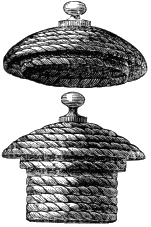
Whatever difference of opinion there may be as to the expediency of the practice of placing straw hives in the open air, independently of a house or shed, the custom prevails to so great an extent, that our object would be incomplete were we not to point out some of the modes resorted to for protecting them in such cases.
Of the commoner kinds of coverings many are sufficiently unsightly; some being of straw thatch (or hackles), others of earthenware, in various ugly forms, and often objectionable and injurious to the hive, from their weight. In the apiary of a friend I have seen a dome-formed straw cover to a stock-hive, constructed with a projection all round of about three inches.
On the underneath side are attached three or four bands in a circle, fitting over the outer diameter of the hive. The appearance of this cover is appropriate; but unless carefully painted, wet will eventually find admittance. It may, however, be rendered water-proof by means of some kind of cement. I have sometimes used for this purpose a mixture of paint with fine sawdust, pounded into the consistence of paste, and afterwards painted and varnished.
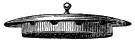
A cover of the same form can be manufactured in zinc, more or less convex, or sometimes nearly flat, its edges being turned down over stiff wire. A descending rim of not less than two inches deep is attached to the underneath side, encircling the upper edge of the hive.
There ought to be perforations immediately under the projection of the rim, and a space left between the cover and the crown of the hive, for the passage of air; or a small worked mat, of straw bands, may be interposed to prevent any ill effect from a hot sun.
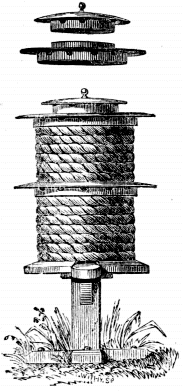
A modification of the last-described zinc cover I have used satisfactorily for the protecting of flat straw depriving hives, requiring more than one story in height. Immediately upon the stock-hive is introduced what, for want of a more distinctive term, I call a shade, encircling the upper edge, as just detailed, with the same kind of descending rim and air-holes.
It is made of moderately thick sheet zinc, cut of such exterior diameter as to leave a projection round the outer edge of the hive of three to four inches, and turned a little downwards over stout wire, to throw off wet. In the centre of the shade is a circular opening, which, if required, may be of the same diameter as the interior of the stock-hive, and round it is a raised rim, standing up not less than half an inch. Within this central opening it is intended to place the super, of whatever kind it may be.
A reference to what has been said at, and the illustrations there given, as well as those now annexed, will show the construction of the shade; also the mode of covering the super by means of a second straw hive (made with or without a crown), standing upon the shade, the upright rim of which keeps it in its place. On the top of this upper hive a second shade, made like the first, may be placed.
The completion of the whole is a slightly convex zinc cap, of about two inches in height, fitting securely over the central opening, like the top of a canister or pot. There is a projecting lateral rim to the cap, underneath which air-holes are made, similar to those under the projection of the shade. In winter, and at any time when a super hive is not required, the cap is placed over the shade immediately surmounting the stock-hive, reducing the edifice to one story.
When feeding is needed by the bees, a pan may be introduced for the purpose within the central opening, and covered over by the zinc top. In reply to those who are dubious as to the expediency of using metal coverings, it may be remarked that no inconvenience arises in the present case, as neither the shade nor its cover come in contact immediately with the crown of the hive.
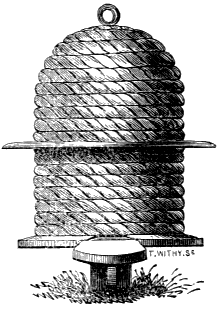 | 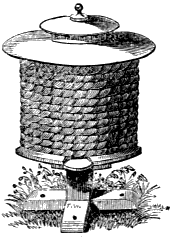 |
If a straw cover to a super is preferred, it can stand over the rim of the shade, as seen in the illustration.
An effectual protection to a round hive may be made by means of an outer case, in fact merely a straw cylinder, with open ends. It must in diameter be large enough to drop loosely over the hive, and rest on the floor-board. The height ought to be sufficient to include any supers that may be required. Surmounting the whole, either one of the zinc covers, shown at, of an enlarged size, can be used; or the shade and its top, as seen at.
FLOOR OR HIVE-BOARDS
The floor on which a hive is placed should be of wood, and not of any material too retentive either of heat or cold, as stone, slate, &c. In summer, the melting of the combs often results, and in winter, numerous lives are lost from chill. Every hive, of whatever kind, should stand upon its own separate board, so as to give facility for lifting, cleaning, or weighing the whole together at any time, without disturbance to the bees.
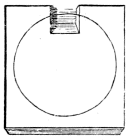
The entrance into a hive is generally cut out of its bottom edge. This has a tendency to cause decay in that part, particularly if of straw; besides that, a hole so made affords but indifferent protection from driving wet or a scorching sun, and gives imperfect facility for the escape of moisture from the hive. It is a better plan to sink the passage out of the thickness of the floor-board, till it reaches the inside of the hive.
There are several ways of doing this, but a simple one is the following: Let the board be of thick, seasoned wood, and to prevent warping, screw two strong cross-bars to the underneath side, seven or eight inches apart. In size the floor-board ought to be a little larger than the exterior of the hive, from whence it should be chamfered down every way, to three eighths of an inch at the edge. From the latter, the entrance must be cut or grooved out, straight and level till it enters the inside of the hive, when it may slope upwards.
This groove may be about four inches wide, and three eighths of an inch deep where the hive crosses it; for it is better in all instances that the requisite space at the door should be given laterally, rather than in height. This is not only more convenient to the bees, but shuts out from admission into the hive such guests as the snail or the mouse.
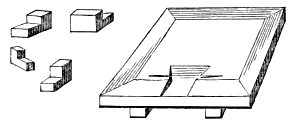
In a board thus constructed a convenient mode of occasionally contracting the entrance-way is by means of small wooden blocks, of different widths, so formed that the lower half can be pushed within the hive’s mouth. The board just described, and its blocks, are shown in the engraving beneath.
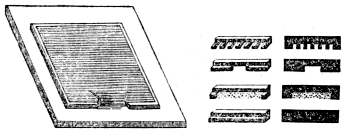
Another kind of hive-board, suitable for some description of boxes, is made by cutting a rabbet of any required width, and three-eighths of an inch deep, on all its sides, leaving the raised part of the board the size of the outside of the box, with an additional half inch beyond this, every way. The passage into the hive is to be cut from the edge of the rabbet, and on the same level, for about two inches; after which it must slope upwards.
It may be four to five inches wide, and its sides should bevel a little outwards. This gives facilities for the introduction of moveable blocks or mouth-pieces, for the convenience of contracting or altogether stopping up the entrance, as may be required. The blocks are an inch wide, and must all be of one size, and of the same length and bevel as the entrance-way.
In height they should be three quarters of an inch in front; cut down behind, half the width to three eighths of an inch. Thus made, the lowest half inch of the block is inserted within the mouth of the hive, and the other half projects on the outside.
To suit all cases and seasons, blocks so formed may be cut on the lower part, from front to back, with any required passage-way through them at pleasure. The preceding engraving exhibits one of these boards, with a front and back view of four blocks thus varied; the third one being fitted with perforated zinc.
An entirely covered entrance, for those who desire it, is afforded by a double board, in which the passage is cut through the floor, altogether within the hive; and it may be thus made:
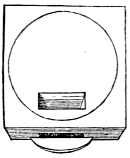
Take a piece of inch seasoned wood, an inch or two broader and longer than the hive. Smooth both sides, and underneath it cut a groove four or five inches wide, and four inches back from the edge. The part next the edge should be there hollowed out three eighths of an inch deep, increasing to double this at the other end, where it enters the hive.
An opening through from the upper side must be made, to meet the underneath hollow, giving a gradual slope down into it. A piece of three-quarter inch board, seven to nine inches wide, must then be screwed underneath, the grain crossing the other; the doorway for the bees being of course between the two. The lower board should be a little the longest, the extra length being intended to form a small alighting board in front.
All the boards in the preceding illustrations are shown square as to form; but any of them may at pleasure be made round.
HIVE-STANDS, OR PEDESTALS.
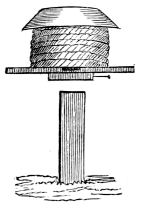
Hives standing singly, in the open air, must be so placed as that there is no risk of their being overthrown by the wind or other casualty, and various kinds of supports have been devised. Whatever is preferred, it ought to afford facilities for allowing the lifting up of the hive on its board at pleasure. A single pedestal or post is sometimes used, cut flat at the top to six or seven inches square.
It may stand out of the ground fifteen or sixteen inches, and be firmly fixed, to avoid shaking, which alarms the bees. Sometimes a higher elevation than this is given, but it is not expedient to subject the hives unnecessarily to the action of the wind, any more than it is to place them so near the ground as to cause the bees to be affected by damp exhalations.
On the under side of the centre of the hive-board fix four bars of wood (or three will do), of about two inches square, so as to form a cap or socket, fitting over the top of the pedestal. The board may be there secured by the insertion, diagonally, of one or two pins, through the sides of the cap and into the post. This plan may be varied by means of the two pieces or arms, let edgewise flush into the top of a post, crossing it diagonally: on this the hive-board may rest, or be secured by a button or two.
Or, on the top of a pedestal, four or five inches in diameter, a piece of board, of about nine inches square, may be fixed as a table. Upon this place the hive-board, of which the cross bars, appended to its underneath side, are so adjusted in point of distance apart, as to come on each side of the table, being there secured by a pin or turn-button.
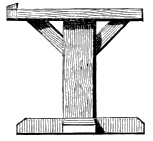
This last-described stand may be improved, at a little further cost. Nail upon the pedestal a piece of strong board, eight or nine inches wide, and three inches longer than the outside width of the hive-board. Underneath the table thus formed, a couple of struts or angle-pieces must be fixed, to render the whole firm.
The under-side bars of the hive-board are adjusted to fall on each side the table, as before detailed. The extra three inches of the latter must be thrown to the front, where it is designed to form a projecting alighting platform for the bees. This part is occupied by a piece of wood nailed to it, and chamfered to meet the hive-board, to which it forms a stay.
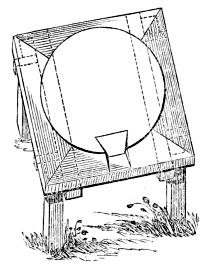
Another support to an out-door hive is made by means of four props, driven upright into the ground, and cut off level, at about sixteen inches high. The hive-board must have two cross bars screwed to its under side, from front to back, just coming within the uprights: to make it still more steady, four small blocks can be appended near the corners, between the cross bars and the edge of the board, to hold the latter in the opposite direction, as seen by the dotted lines in our illustration.
The same remark applies to the hive-stands just described as was made in the last section, viz., they can be adapted equally well to round as to square hive-boards. It may be well also to observe that, instead of sinking a pedestal into the earth, where decay soon ensues, it can be fixed upon strong cross pieces or feet, these being fastened to the ground by pins passing downwards through them.
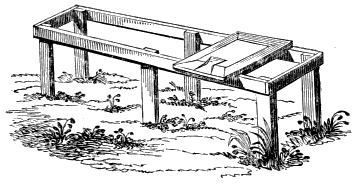
Where there are a number of hives, instead of a separate stand for each, they may be placed more economically, and perhaps safely, on what I term a hive-range, of any required length. The range consists simply of a couple of rails, about an inch thick, and four inches in depth, nailed to the top outer edge of a series of posts, fixed firmly in or on the ground, about eighteen inches high.
The space between the rails may be about twelve inches, measured withinside. The most suitable hive-board for a range is that shown at. The cross bars on its underneath side must be so cut in point of length, as to fall within the two rails, where they are held; whilst what remains of the width of the board lodges upon them, with a convenient projection before and behind. Nor does it matter whether the hive-boards are made square or round.
A range of this kind occupies very little space, and presents few facilities for the incursions of insects or other annoyers of bees. The hives ought to have a good interval between each; but it is an advantage that on this plan they can be moved, by sliding the boards to the right or left, if circumstances call for it. A range on the same principle might readily be made ornamentally, in part or wholly of iron, standing on feet, moveable anywhere, and setting vermin at defiance.
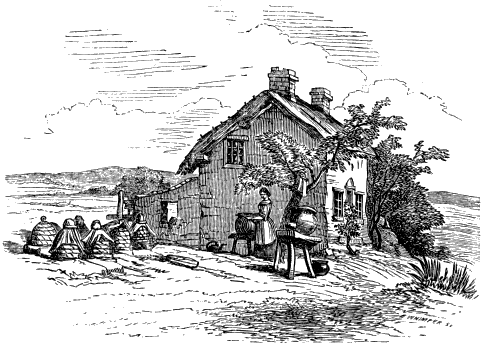
To the intelligent reader it is unnecessary again to repeat, that bee-stocks ought always to be raised sufficiently from the ground to protect them, not only from the baneful effects of damp, but from the incursions of vermin, &c. But inattention on this point is sometimes met with so gross, that we cannot forbear giving place to the preceding engraving, from a drawing made on the spot in Dorsetshire, illustrating the treatment to which the poor bees may be sometimes subjected by indifference or deplorable ignorance.