
ARTIFICIAL SWARMING.
Advantages—Driving: Close and Open—Transfer to Bar-Frame Hive—Conditions of Successful Driving—Various Methods of Artificial Swarming with Bar-Frame Hives.
There are some mortifying incidents connected with natural swarming, which the skilled apiarian will endeavour to avoid, by taking the matter of the making of colonies into his own hands. We have spoken already of the annoyance and trouble often caused by the flying away of a swarm. This accident at the beginning of the honey-season means, at least, a loss of what would be worth from a sovereign to thirty shillings, either in stock or honey.
Another, but minor, disappointment comes from seeing the bees hanging outside a hive in handfuls, idle and useless, waiting for the queen to come forth with a swarm. In this way the work of some thousands of bees for several days is lost, and that often at a time when honey is most plentiful in the fields. Now, both these difficulties may be met with complete success by what is called artificial swarming—an operation which is conducted in different ways, according to the kind of hive to be operated upon.
We will speak of the process called driving. This is the method adopted with the ordinary skep, and is practised as close or open driving. In the first case, the plan pursued is as follows: Into the entrance-hole of the hive to be operated upon a few good puffs of tobacco, or other smoke, are blown.
This frightens the bees, and they immediately rush to the cells, and gorge themselves with honey. After giving them a couple of minutes for this purpose, they become much more quiet and tractable. If this precaution be not taken, many of the workers will fly in anger at the operator, and, though he may be protected by veil and gloves, will greatly disturb the comfort of his manipulations.
The hive is then lifted from its floor-board, and inverted, i.e. turned upside down, on a tub, pail, or pan, partly filled with water, to keep it firm. Upon it is placed an empty hive of the same diameter, and round the junction of their rims is tied carefully a round-towel, or a bandage of some kind, so as to prevent the escape of any of the bees.
At the same time, or as soon as possible, another empty hive, with a little syrup sprinkled on the interior, is put on the stand from which the stock has been brought, so that the bees, who were abroad when their home was removed, may be amused, or, at least, diverted from going to other hives, where they would be attacked and slain as robbers. Returning then to the hive from which the swarm is to be driven, it must be beaten smartly, but not sharply enough to shake down the combs. A tolerably stout stick in each hand, or the hands themselves, may be used for the purpose.
It is best to begin gently, and to increase the force of the blows, letting the drumming be continuous, but not violent. The bees, already terrified by the smoke blown amongst them, will in the course of a few minutes begin to run into the upper hive, and a large enough proportion, together with the queen, will have gone up within ten minutes or a quarter of an hour.
Their passage up may be ascertained by the buzzing sound of the multitude of vibrating wings; and when this has subsided the cloth may be taken away, and a large cluster of the driven insects will be found in the top hive. This should then be placed on the stand from which the stock was taken, so as to be reinforced by many of the population who were abroad for supplies. If it is intended to transfer the new colony to a bar-frame hive, they can be introduced either by being shaken on to the tops of the frames, to run down between, or thrown on a sheet in front of the bar-frame hive, which should be slightly propped up, as already described in speaking of natural swarms thus put into wooden hives.
The old stock, containing much brood and a fair residue of bees, may be placed at a short distance from its former stand. It will be sure to have an attraction for many of the adults of its population so unceremoniously ejected, and some of the most recently hatched will have refused to quit it. These combined forces will suffice to tend the brood; and in a few weeks, with a young queen, the tenants will be almost as numerous as before the driving took place.
Open driving is performed in a similar way, except that the hive, into which the bees are to be made to ascend, is placed over the other at an angle, and only resting upon it for three or four inches. It is supported in this sloping position by skewers or iron wires thrust through both hives where they touch, and with others to prop them well open in front.
This arrangement frees the hands of the operator: enables him, in many cases, to watch the going up of the queen an all-important matter for the success of the artificial swarm: and gives him the opportunity of judging when a sufficient number of the stock have been frightened out of their abode to form a satisfactory colony. The terrified insects make no attempt to escape by the wide opening free to them, but rush in a continuous stream up the connected portions of the hives, and form a cluster in the roof of the upper one.
They have filled themselves with honey, and, between repletion and fright, are as inoffensive as so many flies. We have ourselves had the opportunity of displaying to two members of the Royal Family the harmlessness of driven bees, by taking some hundreds with an ungloved hand, and holding them to the view of Prince Christian and Princess Beatrice. To the Prince’s inquiry, “Why do they not sting?” the reply was, that they became like Englishmen after a hearty meal—very good-tempered, an answer which not only amused His Royal Highness, but was correct as an explanation.
The best time for the operation of driving is near the middle of the day, when many of the workers are abroad in the fields. Should the weather be cold, it is advisable to warm the skep into which the driving is to take place. A further detail of great use in quieting and reconciling the ejected colony is, to sprinkle between the combs, a quarter of an hour before driving, some weak syrup, made of one pound of sugar to one pint of water.
A wine-glassful will be enough to use for one hive, as too large a quantity might seriously wet the bees, and perhaps glue their wings and limbs harmfully. After settling down in their new home, they will be occupied with clearing themselves and each other of the syrup, which will serve also the purpose of still further replenishing their honey-bags.
It is difficult to get the bees to leave by drumming a hive only partly filled with comb. They will cluster about the unoccupied portions, and resolutely refuse to go. In this case they may be ejected on to a sheet, spread to receive them, by three or four sharp jerks in a downward direction.
It is advisable not to drive a colony after very hot weather, and when there is a great in-take of honey: otherwise some of the liquid will begin to flow out of the cells when the-skep is inverted, and will cause much trouble and waste, and possibly the destruction of many bees by drowning them in their trickling stores.
It will be better to wait till the next morning, when evaporation and the coolness of the night will have thickened the liquid sufficiently for it to remain in the cells during the manipulation. The combs, also, will have become firmer, and less liable to fall, with the diminished temperature.
The operation of driving from skeps is abundantly practised by apiarians, in the autumn, among the hives of those cottagers who would otherwise follow the old and most barbarous plan of killing their bees to take the honey. Several stocks of bees thus drummed out of house and home may be united to form a strong colony.
If supplied with frames of comb, or “foundation,” and fed with syrup (made with 21/2 lbs. of sugar to each pint of water, with a dessert-spoonful of vinegar boiled up with it, to prevent crystallisation), they may be brought safely through the winter, and become, by the spring-time, well worth the expense and trouble they have cost.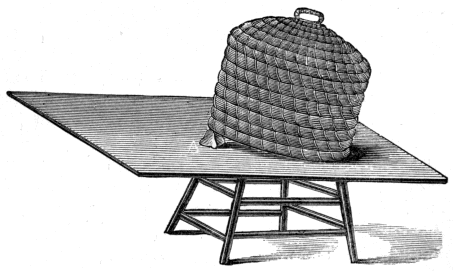
Fig. 63.—Swarming Board.
With bar-frame hives the making of artificial swarms becomes an easy matter, and more than one plan may be adopted. In the first place, suppose it is desired to transfer into a skep a swarm from a wooden hive, for sending to a distance. The preliminary operations are as follows: Towards evening, remove the stock a few yards from its stand, and have ready the skep on a wide board, and propped up two or three inches in front.
Next puff smoke into the midst of the bees, to quiet them, and to induce them to fill their honey-bags. Then lift the frames one after another, and search for the queen till found. Take her gently between the first finger and thumb, seizing her by the wings, place her at the entrance of the skep, and see that she runs in. Shake on to the board, close to the skep, the bees from the frame on which the queen is found, and, after replacing it in its own hive, take out and shake off bees from other frames in succession, till a sufficient amount to make a swarm has been let run into the skep.
They, with their sovereign, will ascend to the crown of their abode, and then may be secured by tying a cloth over the open part of the straw hive, and despatched to their destination. Of course the frames must be replaced in the stock hive as they are cleared. The remaining bees will soon make a new queen for themselves, and will care for the developing brood. Judgment must be exercised, so as not to weaken too greatly the population of the parent-hive.
Another method, still simpler, is to begin operations in the morning of a bright day, and to shake off the queen and bees from two frames only, and put the colony on to the old stand, removing the stock to a distance of a few yards. The bees abroad for supplies will, on their return, remain with their queen, and make up a sufficiently strong community; while the young, and those who prefer the old stock, will be sufficient to meet its requirements.
A third plan is to take the frame on which the queen is, with bees and brood, and place it, with two or three other frames from the same stock in another hive, which should be placed on the old stand. Foragers returning from the fields will, as in the preceding case, reinforce the new colony, while the stock, moved to a little distance, will soon repair the loss of their queen, and hatch out young bees in place of those transferred to another home.
A fourth method is to take two combs from each of several strong stocks, brushing off all bees with a feather or goose-wing. Then placing the hive thus filled with comb and brood, on the stand of a strong stock, the returning bees will take to the home thus presented to them, and will speedily raise a queen for themselves from one of the many eggs contained in the brood cells.
The displaced hive must, as in previous instances, be removed a few yards from its old position. The reason for filling the abode of the new community with frames of worker-brood, is to prevent the bees from building drone-comb, and raising males only, as they are apt to do when they have to manufacture a queen, at least till she is not only hatched but begins to lay eggs.
There are three or four important precautions which are to be remembered when making artificial swarms. Firstly—swarming should not be artificially attempted till drones are tolerably numerous, unless a fertile queen is to be given to the new colony Secondly—honey should be abundant when the swarm is made, unless a good deal is stored in the combs removed. If syrup, however, be supplied, all danger from scanty sources outside will be removed.
Thirdly—swarms should be taken only from the strongest stocks, otherwise both old and new communities will be, perhaps irretrievably, ruined. Fourthly—it is an immense advantage to introduce a queen into the hive that has been deprived of its mother-bee; and with suitable precautions, especially that of caging the supplied sovereign for thirty-six hours in a receptacle made for the purpose, there is usually little difficulty in getting the substitute amicably received by the mourning workers.
This plan not only prevents the loss of two or three weeks of very valuable time in the rearing and fertilising of a queen, but obviates the danger of the young queen, when raised, perishing on her wedding-flight, through being snapped up by a bird, or mistaking the entrance of her hive on her return.
Various modifications of the above plans may be found in Langstroth, but enough has been said to indicate the ordinary and simplest modes of procedure.