
POLLEN, OR BEE-BREAD.
Origin—Collection—Conveyance—Deposition—Quantity Stored—Uses—Artificial Substitutes.
Honey consists, like most saccharine substances, of carbon, oxygen, and hydrogen. It is fitted, therefore, as a food to supply the waste in the body of the bee produced by respiration; but for the nourishment of muscular tissue, and so for the growth of the larvæ and pupæ, some nitrogenous material is required. This is obtained by the insects from the pollen of flowers. This substance, we need hardly say, is the fertilising powder necessary for the production of seeds in plants, and growing on the anthers, or tops of the stamens, within the corolla of most flowers.
The workers in search of honey rub off this farina with their hairy bodies and with the bristles of their legs. Then, on taking wing, they clear it off by rapid combings of their limbs; and rolling the powder into little pellets, they deposit it in pockets situated on the outside of the middle joint of the hindmost pair of legs. When filled, these receptacles with their loads appear like coloured balls on the laden workers.
Sometimes the bees get so covered with pollen from plants containing large quantities of it, that they cannot clear themselves of the powder till they return to their homes; and, in some cases, they need the assistance of their fellows to brush off what adheres too tightly, or in places not easily reached by the individual herself.
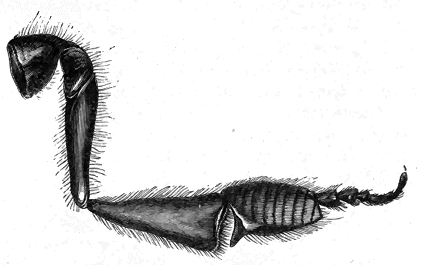
Fig. 21.—Hind-leg of a Bee.
When the pollen-laden bee has reached the combs, she searches for a cell already containing the same material as that she is carrying, or which is suitable for her purpose. Then, having found what she wants, she inserts her hindmost legs into the cell, and, by a dexterous movement, detaches the little balls, and, on retiring, gives herself some vigorous shakes, as if to clear herself of still adherent flower-dust. Then another worker, whose duty it is to see to the proper storing of the bee-bread, rams it down with her head into a compact mass, and the process goes on till the cell is filled.
No particular portion of the combs seems selected for the deposit of this substance, nor is it ascertained that what is procured from any particular kind of plant is placed apart; but a mixture of various pollens appears to be made, though during the prevalence of any special flower yielding the material, certain colours predominate, as might be expected, in the stores of bee-bread.
The quantities collected by a prosperous colony must be very great. Some writers put the amount at twenty pounds in the course of a season. The carrying in of this produce is usually a sure sign that there is brood in the hive. The absence of a supply going in generally raises the suspicion that no young are developing, owing to the loss of the queen. The amount seen to be carried in is, therefore, a rough indication of the prosperity of the community.
In early seasons its collection begins as soon as February. During April and May, i.e. in the height of the blossoming time, the largest quantities are stored; and this period corresponds with the most rapid and extensive increase of the population of the hive.
The nurse-bees take some portion of the pollen immediately it is brought in, and, working it up with honey and saliva, prepare the food for the larvæ. In some cases, they partially digest it before giving it to the young brood. It is believed that the queen, when laying her thousands of eggs, needs copious supplies of nitrogenous nutriment, and that her attendants diligently feed her with honey mixed with bee-bread, which has been partly prepared in their stomachs for quick assimilation in the body of their monarch.
When plant-blossoms are scarce, the skilful apiarian supplies his stock with some substitute for pollen. Dr. Dzierzon was the first to propose fine rye-meal for this purpose; and he was led to make the suggestion by having noticed, that, in the early spring, before flowers were blooming in sufficient quantity to satisfy the wants of his bees, they entered a neighbouring mill, and returned to their hives well powdered with rye-flour.
Pea-meal has been tried with much success for this purpose. The method of using it recommended is to put the meal into a soup-plate, or shallow dish or trough, among shavings. The bees may be enticed to take to it by a little honey placed on the rim of the receptacle, or by showing a few individuals the way to it. When once the treasure has been discovered by the workers, they make abundant visits to it.
They, indeed, prefer the pea-flour to the old stores of bee-bread remaining in the hive; but, so soon as the natural supplies of the plant-blossoms are sufficient in amount for the wants of the brood, the substitute is quite neglected.
In extracting honey from combs by pressure, it is well to avoid any admixture of the bee-bread, as its taste is by no means a pleasant addition to the flavour of the sweet liquid. By using any of the “extractor” machines now in vogue, all danger of having the pollen mingled with the honey is avoided.